
The Experience
In the quiet moments when the world retracts its demands, a particular experience often seizes us—a sensation as elusive as it is profound. It comes unbidden, like the hush that falls over a room when a secret is about to be shared. It is the awareness of time not as a linear procession of moments, but as something more complex, a tapestry woven with the threads of past, present, and future, all existing simultaneously within the mind. One might be sitting by a window, watching the dance of leaves in the wind, or standing in a museum, gazing at a painting that seems to breathe with its own life. In these instances, time loses its ordinary cadence. We feel as though we are at the center of a vast network of experiences, every moment connected by an invisible thread.
This experience, while intensely personal, resonates with a universal familiarity. It is the sudden recognition that the past, while seemingly distant, is intimately present within us, carried in memory. The future, too, though seemingly uncertain, tugs at our consciousness with its promises and fears. In these moments, one realizes how deeply intertwined time is with consciousness, how our perception shapes and colors the very essence of reality. It is a sensation that can evoke a profound sense of peace or, conversely, a haunting awareness of life's fragility.
Yet, this experience is not confined to grand, solitary reflections. It emerges in the mundane, in conversations with friends that replay in our minds, in the familiar cadence of footsteps on a city street, in the scent of a childhood room. Time, in these moments, unfurls into a vast, interconnected whole, challenging the boundaries we so often take for granted.
Unpacking the Experience
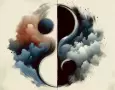
To understand this experience more deeply, we must consider the nature of time itself. Time is often depicted as an arrow, flying in one direction, marking the passage from birth to death, from creation to decay. Yet, when we step back from this linear view, we encounter the notion of time as a circle, or even a spiral—a continual return, where each moment bears the imprint of those that preceded it and influences those yet to come.
This cyclical understanding of time invites us to rethink cause and effect, to see them not as a straightforward chain but as a web, where each node connects in myriad ways to others. Consider the act of remembering a childhood friend: the memory is not static but alive, reshaping itself as we grow, influencing our present perceptions and future decisions. The past is not a locked box, but an active participant in our ongoing narrative.
Moreover, our understanding of the present moment is intricately tied to our anticipations and recollections. Our consciousness does not merely reside in the now; it stretches forwards and backwards, entwining with dreams and memories. This elasticity of time within the human mind is both a gift and a burden, allowing us to project and reflect, but also to become trapped in nostalgia or anxiety.
What It Reveals
This complex interplay of temporal dimensions reveals a profound truth about human experience: that we are not mere passengers carried along by time, but active creators of our temporal reality. We shape and are shaped by the stories we tell ourselves about the past and the futures we imagine. Our identities are constructed within this continuous dialogue between memory and anticipation.
In recognizing this, we come to see that what we call the present is not a mere point between past and future, but a dynamic space where all times converge. It is in this convergence that we find the essence of our agency, the ability to choose, to act, to transform. We realize that our lives are not determined by an inexorable sequence of events, but by how we engage with the threads of time.
This insight also compels us to reconsider our relationship with change. If time is not a relentless force sweeping us away, but rather a medium through which we navigate, then change is not something to be feared but embraced as an integral part of our being. Each moment of transformation is both an end and a beginning, a confluence of what has been and what might be.
Living With This Knowledge
How, then, do we live with this understanding of time? It calls for a reorientation of our values, a shift from seeking permanence and certainty to embracing the fluidity of existence. It invites us to cultivate a deeper awareness of the present moment, not as a fleeting instant but as a rich tapestry of interwoven times.
This awareness encourages us to live with intentionality, to recognize that our choices reverberate through the dimensions of time, affecting not only our own lives but the lives of others. It suggests a way of being that is attentive, humble, and open to the possibilities that each moment holds.
Moreover, this knowledge can foster a sense of compassion, both for ourselves and for others. Understanding that we are all navigating the intricate dance of time, grappling with memories, hopes, and fears, we can approach each other with empathy and patience. We learn to see others not as static characters in our story but as fellow travelers, each with their own complex relationship with time.
Ultimately, living with this knowledge is about embracing the mystery of existence, finding beauty in the complexity of our temporal experience. It is about acknowledging our place within the vast flow of time, realizing that, in some strange way, we are already where we need to be.