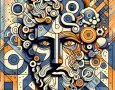

The Teaching
In the quiet murmurs of ancient philosophy, there emerges a voice that speaks of the profound and often unsettling idea: the unity of being. This teaching, distilled from the writings of a sage who traversed the realms of thought on the chariot of reason, asserts that reality, at its core, is singular and unchanging. To truly know is to recognize the permanence and oneness of what is. The sensory world, with its multiplicity and change, is an elaborate facade that obscures the eternal truth of existence.
This doctrine of 'what is' stands in stark contrast to the multifarious world of appearances. The world we perceive, with its transience and diversity, is deemed illusory, a deceptive play of shadows that fails to capture the essence of reality. Instead, the teaching invites us to consider the possibility that what truly exists is beyond the grasp of our ordinary experiences. It challenges us to seek knowledge not through sensation but through reason, which alone can reveal the unalterable core of being.
Understanding Its Depth
The potency of this philosophical insight lies in its radical reevaluation of what it means to know. In suggesting that only one path leads to truth, it compels us to reconsider the reliability of our senses and the certainty of empirical knowledge. By proposing that the mind, when unfettered by the distractions of the sensory, can access the singular reality, it elevates thought itself to a nearly divine status.
Yet, the implications extend beyond epistemology into the realm of metaphysics. If reality is singular and immutable, then change, difference, and plurality are but illusions. This notion strikes at the heart of how we understand the world and our place within it. It invites us to ponder the unity underlying the apparent chaos and complexity of existence, to find peace in the notion that beneath the surface turmoil lies a serene and unchanging truth.
Common Misunderstandings
One common misconception is to dismiss this teaching as a denial of the reality we experience daily. It is not a call to ignore the sensory world but to transcend its limitations. The teaching does not negate the experiences of the world; rather, it insists on their incompleteness. To understand it as a wholesale rejection of empirical reality is to miss the subtlety of its wisdom.
Another misunderstanding is the assumption that this perspective renders the world inert and lifeless. On the contrary, by emphasizing the unity and constancy of being, it offers a vision of the world suffused with an underlying vitality, a continuous presence that persists against the ephemeral nature of appearances. This teaching does not strip life of its dynamism but redirects our attention to the source of that dynamism, which is the eternal.
Practicing the Wisdom
To practice this wisdom is to engage in a disciplined act of contemplation. It calls for a turning inward, a quieting of the mind to attune to the symphony of the singular being. In a world filled with distractions, this practice demands a deliberate focus, an effort to perceive the eternal beneath the fleeting.
We might begin this practice in moments of reflection, where we allow the noise of the external world to recede and engage deeply with the questions that matter. It is an invitation to meditate on the unity of existence, to seek out the connections that bind disparate experiences into a cohesive whole. This meditative approach can lead to a richer, more profound understanding of our place in the cosmos and of the eternal truth that underpins it all.