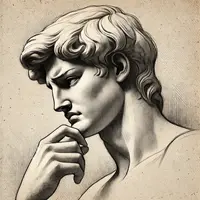

First Encounter
In a secluded corner of the public gardens, two figures find themselves drawn into conversation by the serene beauty of the morning sun filtering through ancient trees. Helen, a seasoned philosopher known for her piercing intellect, sits upon a stone bench with a slim volume in her lap. Across from her stands Marcus, a young poet whose restlessness is as palpable as the wind that stirs the leaves. Their eyes meet, and a silent understanding passes between them—a shared curiosity about life’s deeper questions.
“What is it you seek in these pages, Helen?” Marcus asks with a half-smile, gesturing to the book she holds. “Do you find answers to the questions that haunt the human soul?”
Helen closes the book softly, her fingers tracing its spine as though seeking to draw forth its essence. “I seek not just answers, but the right questions,” she replies, her voice steady. “A life well-examined demands more than mere solutions; it requires the courage to question that which we take for granted.” Marcus nods, intrigued. “And what assumptions do you challenge today?” he inquires, a spark of eagerness in his eyes. Helen pauses, considering her response. “Today, I ponder virtue—not as a mere abstract ideal, but as a living force within us. Tell me, Marcus, what does virtue mean to you?”
Going Deeper
Marcus leans forward, contemplating the question. “Virtue,” he muses, “is like poetry—a fleeting truth that reveals itself in moments of beauty and clarity. It is the essence of our best selves.” Helen listens, her gaze steady, encouraging him to delve further. “Yet, if virtue is so ephemeral, how can it guide us in the chaos of everyday life? Does it not require more than mere recognition?”
Helen’s query lingers in the morning air, challenging Marcus to reflect more deeply. “Perhaps virtue is both a beacon and a burden,” he offers. “It lights the way, yet demands vigilance. We are constantly tested by desires and distractions.” Helen nods, acknowledging the struggle implicit in his words. “Indeed,” she agrees, “virtue is not a static state but a dynamic process, an ongoing pursuit in the face of life's complexities.”
Marcus furrows his brow, thoughtful. “But how do we cultivate such a pursuit? Is it through habit, as some suggest, or is there a deeper transformation required—a reshaping of the very core of our being?” Helen’s eyes light up, recognizing the heart of their inquiry. “Let us explore that very question,” she proposes, “and see where it leads.”
Deeper Still
As the discussion deepens, the tranquil setting seems to fade, leaving only the intensity of their exchange. “Consider,” Helen begins, “the role of intention in virtue. Is it enough to act rightly, or must we also intend goodness to truly be virtuous?” Marcus ponders this, aware of the tension between action and intention. “Can we separate the two?” he counters. “Does not every action stem from an intention, even if it is unexamined?”
Helen smiles slightly. “And therein lies the challenge: we must bring our intentions to light, scrutinizing them with honesty. It is not enough to act; we must understand why we act.” Marcus nods slowly, seeing the intricacies unravel before him. “So, virtue is not just a matter of doing, but of knowing—knowing oneself, one’s motives, and the impact of one’s actions.”
Helen agrees, her voice softening as she continues. “And this knowing requires courage—the courage to face uncomfortable truths about ourselves. It is easy to hide behind the façade of righteousness, harder to confront the shadows within.” Marcus feels the weight of her words, a silent challenge to both their characters.
The Center
In this moment of clarity, both Helen and Marcus recognize they have reached a pivotal point in their conversation. “We stand at the center of our inquiry,” Helen declares, “the nexus where thought and action converge. Here, we must ask: what compels us towards virtue?”
Marcus reflects on this, the garden’s tranquility mirrored in his thoughtful silence. “Perhaps it is the desire for harmony,” he suggests, “a harmony within oneself and with the world. Virtue aligns us with a greater order, a cosmic choreography.” Helen considers this, nodding. “Yes, and yet, it must also be personal, deeply rooted in our individual lives. Virtue is universal in its appeal, yet particular in its application.”
Their dialogue hangs in the air, each word a stone in the path of understanding. “And what of failure?” Marcus asks suddenly, his voice tinged with vulnerability. “In striving for virtue, we will falter—how do we reconcile our imperfections with our ideals?” Helen meets his gaze, her tone firm yet compassionate. “Failure is not the antithesis of virtue, but its companion. It is through our failures that we learn, grow, and renew our commitment to the path.” Marcus nods, a sense of acceptance settling within him.
Returning Changed
As the sun begins to arc towards its zenith, casting long shadows across the garden, Helen and Marcus sense that their conversation is nearing its natural conclusion. “We will leave this place, but not as we came,” Helen observes. “Our understanding of virtue has shifted, deepened.” Marcus smiles, a lightness in his countenance. “Indeed, it feels as though a veil has lifted, revealing new vistas of thought and possibility.”
They rise from their seats, the world around them vibrant with the promise of discovery. “The journey does not end here,” Helen reminds him. “Each day offers a new chapter in the narrative of virtue, a chance to write with clarity and purpose.” Marcus nods, ready to embrace the challenges and insights that await. “Let us carry forth what we have learned,” he agrees, “and let it guide our actions, even as it continues to provoke our thoughts.”
With a shared sense of resolve, they part ways, each carrying the flame of their dialogue into the broader world. Yet questions remain, unanswered but essential, echoing in the recesses of their minds, urging them forward on the path of inquiry.