
Setting the Stage
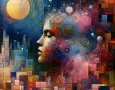
In the vast expanse of the universe, where stars are born and galaxies collide, there exists a peculiar entity—the human mind. Much like the universe it contemplates, the mind is a realm of infinite complexity and wonder. As we stand on the precipice of understanding, a profound question arises: how do we navigate the cosmos of thought, and what is the role of reason in this journey?
Imagine a night sky, clear and boundless. The stars twinkle like distant thoughts, each representing a possibility, an idea yet to be explored. In this celestial tapestry, reason is the telescope, a tool that focuses our sight, allowing us to discern patterns amidst the chaos. It is through reason that we chart our course, seeking meaning in the vastness that surrounds us.
Yet, beneath the surface of this quest lies a tension. Reason, while powerful, is not without its limitations. It demands clarity and logic, often at odds with the emotional and intuitive facets of our nature. As we embark on this exploration, we must ask ourselves: how do we reconcile these forces within us?
The Central Question
At the heart of our inquiry lies a fundamental question: what is the proper place of reason in our lives? Is it a guiding light, leading us to truth and understanding, or a mere tool, to be used judiciously alongside intuition and emotion?
Consider a ship navigating the open sea. Reason is the compass, providing direction in an otherwise featureless expanse. But storms arise, and in the throes of chaos, the compass alone is not enough. The sailor's instincts, honed by experience and intuition, become equally crucial. This metaphor illuminates the delicate balance between reason and the other faculties of the mind.
In exploring this balance, we confront deeper philosophical concerns. Can reason alone lead us to a fulfilling life, or must it be tempered by the rich tapestry of human experience? How do we ensure that our rational pursuits do not blind us to the beauty and complexity of the world?
Historical Perspective
Throughout history, the role of reason has been a subject of vigorous debate. The Enlightenment heralded an era where reason was king, a beacon of progress and emancipation from the shackles of superstition. Philosophers championed the power of rational thought, advocating for a world governed by logic and evidence.
Yet, as history unfolded, the limitations of this perspective became apparent. The Romantic movement emerged as a counterpoint, celebrating emotion, intuition, and the sublime aspects of human experience. For every philosopher extolling the virtues of reason, another voiced caution, urging us not to neglect the depths of human emotion and creativity.
In modern times, this dialectic continues. We live in an age of information, where data and reason shape our decisions more than ever before. However, the resurgence of interest in mindfulness, emotional intelligence, and the arts suggests that humanity still yearns for a more holistic understanding of its place in the cosmos.
Philosophical Analysis
To unravel this conundrum, we turn to philosophy's toolkit. Reason is often lauded as the foundation of knowledge, a structured pathway to truth. Yet, philosophers have long recognized its limitations. David Hume, for example, argued that reason is the slave of the passions, suggesting that our desires ultimately guide our rational deliberations.
Conversely, Immanuel Kant posited that reason is essential for moral development. He envisioned it as a tool that enables us to discern universal ethical principles, thus elevating it beyond mere instrumentality. The tension between these views highlights the complexity of reason's role in human life.
Perhaps the answer lies in synthesis. Reason, when integrated with emotion and intuition, can lead to a more nuanced understanding of the world. Just as a symphony requires harmony between distinct instruments, our mental faculties must work in concert to achieve true wisdom.
Practical Dimensions
The philosophical exploration of reason's role has profound implications for daily life. In the realm of decision-making, relying solely on reason can lead to choices that overlook personal values and emotional well-being. Consider the career-driven individual who, guided by reason alone, pursues financial success at the cost of personal happiness.
In relationships, too, the interplay between reason and emotion is critical. While rational communication is essential, empathy and emotional resonance foster deeper connections. Balancing these elements is an art, one that requires constant practice and reflection.
Ultimately, the goal is not to diminish reason's importance but to recognize its place within a broader tapestry of human experience. By doing so, we cultivate a life that is both intellectually rigorous and emotionally fulfilling.
Psychological Aspects
From a psychological standpoint, the integration of reason with other cognitive faculties is crucial for mental health. Cognitive-behavioral therapy, for example, leverages rational analysis to challenge and reframe negative thought patterns. Yet, it also acknowledges the role of emotion and intuition in shaping our experiences.
Research in neuroscience reveals that the brain's rational and emotional centers are deeply interconnected. Decisions often arise from the interplay of reason and emotion, challenging the notion that they are separate domains. Embracing this complexity can lead to greater self-awareness and personal growth.
Moreover, understanding the psychological dimensions of reason allows us to navigate the challenges of ambiguity and uncertainty. In a world where information is abundant yet often contradictory, the ability to reason critically and empathetically is more valuable than ever.
The Broader Picture
Reason's role extends beyond the individual, influencing societal structures and cultural narratives. In the political arena, reasoned discourse is essential for democratic governance. Yet, as polarization grows, the challenge is to ensure that reason remains a unifying force rather than a divisive one.
In education, fostering critical thinking skills alongside emotional intelligence prepares future generations to navigate the complexities of an interconnected world. It is through this holistic approach that we nurture informed, compassionate citizens.
Thus, the broader picture reveals that reason is not an isolated phenomenon. It is woven into the fabric of society, shaping our collective destiny as we strive for a more just and enlightened world.
Final Reflections
As we conclude this exploration of reason's role in our lives, we return to the night sky. The stars, once distant and enigmatic, now form constellations—patterns of meaning illuminated by the light of reason. Yet, these patterns are not static; they shift and evolve as our understanding deepens.
In embracing reason as a guide, we must remain vigilant, ensuring that it serves rather than dominates our quest for truth. By integrating reason with emotion, intuition, and experience, we chart a course toward a life that is both profound and enriching.
Ultimately, the question remains: how do we balance the demands of reason with the depths of our humanity? In seeking answers, we embark on a journey as infinite and mysterious as the cosmos itself.