
Two Perspectives
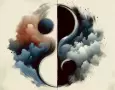
In the silent spaces of our mind, two voices often emerge, one urging caution, the other whispering of adventure. These voices echo what might be termed the dialogue between the conscious and the unconscious. From one angle, the conscious mind is like a vigilant guardian, patrolling the borders of identity and rationality. It insists upon clarity and order, fashioning an existence that fits neatly into the tangible world. Here, the conscious is the craftsman of daily life, laying bricks of experience with precision and intention.
From another perspective, the unconscious is akin to an ancient forest shrouded in mist, its trails meandering through dreams and symbols. It does not adhere to the logical pathways of its conscious counterpart but instead offers a wealth of raw, untamed potential. In this realm, the boundaries of self are porous and ripe with possibilities. The unconscious speaks in a language of archetypes and emotions, inviting us to explore the depths that defy simplistic understanding.
Points of Agreement
Both perspectives acknowledge that the human psyche is not a homogenous entity but a complex and layered tapestry. Each aspect, conscious and unconscious, contributes uniquely to the evolution of the self. There is a tacit agreement that neither can be dismissed without consequence; the conscious, for all its orderliness, would be barren without the creative stirrings of the unconscious. Conversely, the unconscious requires the structure offered by consciousness to manifest its visions into reality.
Moreover, both views concur that the dialogue between these two realms is essential for wholeness. Awareness of the unconscious mind enriches conscious decisions, infusing them with depth and intuition. Similarly, consciousness provides a platform for the unconscious to express itself, transforming vague impulses into articulated dreams. This mutual dependency is a dance, a balancing act where one lends strength to the other, ensuring the psyche's harmony.
Points of Tension
Yet, tension arises from their inherent opposition. The conscious mind may resist the unruly nature of the unconscious, fearing the chaos it might unleash. It clings to the familiar, wary of the unknown that lurks in the shadows. In contrast, the unconscious might view the constraints imposed by consciousness as suffocating, longing for liberation from the tight grip of rationality. This tension can manifest as internal conflict, where desires are stifled by fear or intuition is drowned out by over-analysis.
These points of tension are vividly illustrated in the story of an artist who finds herself at odds with her creative impulse. Her conscious self demands a coherent narrative in her work, yet her unconscious floods her with abstract images and emotions that resist easy interpretation. The struggle between these forces leads to a paralysis that can only be resolved by acknowledging the validity of both perspectives and allowing them to inform each other.
What We Learn From Both
The interplay between the conscious and unconscious teaches us that embracing complexity is pivotal in the journey of self-discovery. We learn that the psyche thrives not in the dominance of one element over the other, but in their integration. By fostering a dialogue between these realms, we open ourselves to a richer, more nuanced understanding of our inner worlds.
Furthermore, this exploration encourages us to respect the mystery of the unknown. Instead of fearing the unconscious, we might approach it with curiosity and openness, recognizing it as a source of insight and creativity. Simultaneously, we come to appreciate the conscious mind's ability to bring structure and clarity, allowing us to navigate the world with intention and purpose.