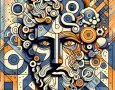

Introducing the Concept
In a world brimming with visible complexity, there is an ancient idea whispering from the margins of our awareness: the notion that the universe, in all its grandiosity, is composed of the simplest of units, invisible to the naked eye. It speaks to a profound simplicity underlying the apparent chaos—a simplicity best understood not through the lens of modern science, but as a philosophical meditation on life's hidden foundations.
Consider the act of walking through a forest. The towering trees, the cacophony of bird calls, and the rustle of leaves underfoot present a tapestry of life. Yet beneath this vibrant scene lies a microcosm of unseen forces and elements. This notion invites us to ponder the nature of reality itself and our place within it, urging us to explore what is not immediately perceptible.
Origins and Context
Dating back to a time when the lines between science and philosophy were yet to be drawn, the ancient thinkers of Greece grappled with questions about the fundamental nature of reality. Among them was a philosopher who postulated that everything we see is composed of tiny, indivisible particles. This idea, radical at the time, emerged from a context of burgeoning inquiry into the natural world, where myth was slowly yielding to reason.
The ancient Greek world was one where the physical and metaphysical were intertwined. Philosophers sought not just to explain the material world but to understand its spiritual and existential dimensions. The assertion that the universe is composed of these basic building blocks offered a compelling explanation for both the sameness and diversity of nature, suggesting a unity underlying apparent plurality.
The Concept in Action
Imagine a potter at work, shaping clay into a vessel with deft, practiced hands. To the potter, the clay is a medium for expression, but the clay itself is composed of countless unseen particles. This image encapsulates the philosophical idea that behind every form lies a foundational substance, which can be transformed yet remains essentially the same.
This concept finds resonance in our daily lives when we reflect on change and permanence. Consider the bustling cityscape: skyscrapers rise, cars speed by, and people hurry along the streets. Beneath this dynamic scene lies a static truth: the city's material is constant, even as its form evolves. Such reflections prompt us to consider the nature of identity and permanence in our own lives.
Critiques and Limitations
Despite its elegance, the notion of an indivisible foundation has not gone unchallenged. Critics argue that it reduces the richness of experience to mere mechanistic interactions. In a world that is undeniably interconnected and dynamic, the reduction of all phenomena to fundamental particles can seem overly simplistic.
Moreover, this idea raises questions about the nature of consciousness and the human experience. Is there room for meaning, emotion, and ethics in a universe understood in terms of basic particles? These questions highlight the limitations of a purely reductionist view, urging us to seek a balance between understanding the parts and appreciating the whole.
Why It Still Matters
In an age dominated by technological advancement and scientific discovery, the ancient insight into the fundamental nature of existence continues to resonate. It invites us to reflect on the hidden complexities of our world and the simplicity that underpins them. This concept encourages humility and wonder in the face of what we do not know.
This notion also serves as a metaphor for understanding human relationships and societal structures. Just as unseen forces bind the universe, so too do unseen bonds—trust, empathy, shared values—hold communities together. By contemplating the invisible, we gain a deeper appreciation for the connections that define our lives.