
Opening Reflection
Imagine a grand library, vast and silent, where each book is a world unto itself. Within its walls, knowledge rests, dormant yet alive, waiting to be awakened. This library is both a sanctuary and a labyrinth, a place where one might find clarity or become hopelessly lost. It is here that we find the paradox at the heart of human experience: the tension between the self as a unique individual and the self as merely a part of the collective tapestry of existence.
As we wander these aisles, we are drawn to the allure of certainty—the idea that within these bindings lies the truth of who we are. Yet, the deeper we delve, the more elusive that truth becomes. Our search for identity is both a quest for unity and a journey into ambiguity. We are, at once, the authors of our own stories and characters in a narrative beyond our control.
Core Thesis
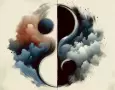
The paradox presents itself: how can we reconcile the intimate knowledge of who we are with the broader currents of history and society that shape us? To live authentically is to acknowledge this tension, to sit with the discomfort of knowing we are both singular and plural. It is to accept that our identities are at once our own creation and the result of forces beyond our understanding.
In this, we find a philosophical conundrum akin to the art of weaving. The threads are distinct, each possessing its own color and texture, yet the fabric they create is seamless. To pull on one thread is to alter the entire tapestry. Likewise, our personal narratives are inextricably linked to the greater human story, each influencing and being influenced by the other in a complex dance of interdependence.
Development
Consider the story of a musician—a solitary pianist composing in a quiet room. Each note she plays is an expression of her individuality, a moment of pure, unfiltered emotion. Yet, that music does not exist in isolation. It draws from the legacy of past composers, the cultural context of her audience, the very physics of sound itself. Her creation, while deeply personal, is also a part of a larger, ongoing symphony.
In much the same way, our self-perception is a composition of various influences: family heritage, societal norms, personal experiences. We blend these elements, consciously and unconsciously, crafting an identity that is uniquely ours yet not entirely within our own making. The challenge lies in embracing this duality without seeking premature resolution, in recognizing the self as both a solitary note and a chord within the universal melody.
Deeper Implications
This paradox of identity invites us to reconsider the nature of freedom and autonomy. Are we truly free when our actions and beliefs are so heavily influenced by external factors? Or does freedom lie in the awareness of these influences, in the choice to accept or challenge them as we see fit?
Moreover, this tension has profound implications for ethics and morality. If our identities are fluid, shaped by the interplay of myriad elements, how do we account for personal responsibility? Perhaps the answer lies not in rigid definitions of selfhood but in a fluid understanding of our interconnections—recognizing that our actions ripple beyond ourselves, impacting the world in unforeseen ways.
Closing Thought
As we leave the metaphorical library and re-enter the world, we carry with us the paradox of our own existence. It is a burden and a gift, a source of both confusion and insight. To embrace it is to acknowledge the complexity of being, to find solace in the knowledge that we are both singular and intertwined.
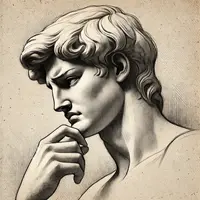
In this acceptance, we may find not answers, but a deeper appreciation for the questions themselves: What does it mean to truly know oneself? Can we ever fully disentangle our individual threads from the fabric of humanity? Perhaps it is in this tension that we find our most authentic selves.