Two Perspectives
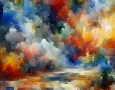
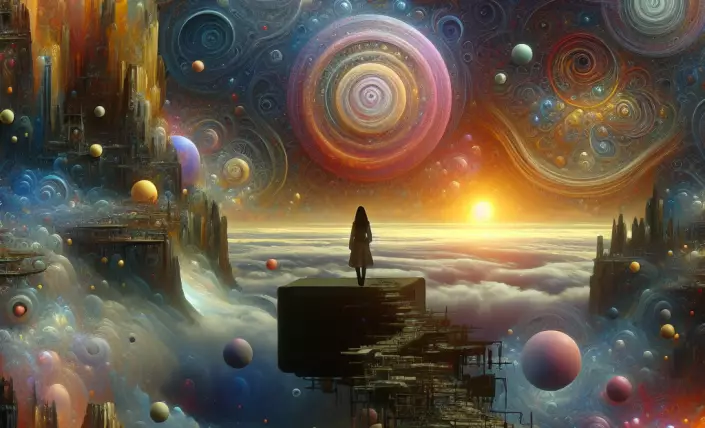
Consider two travelers crossing a vast landscape. One sees a series of paths, each with its own direction, obstacles, and destinations. She marvels at the diversity of experiences each path offers, seeing each decision as a distinct fork with its own universe of outcomes. To her, the world is a tapestry woven with infinite possibilities, each thread representing a different journey. This traveler embodies a pluralistic view, where the multiplicity of paths holds intrinsic value.
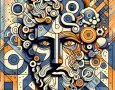
The second traveler sees the same landscape but perceives it as a single, coherent whole. Every path, for him, is not an isolated thread but part of a grand design, a preordained harmony where every choice and every consequence is inevitably interlinked. His journey is one of finding the unity in the diversity, believing deeply in an underlying order that gives meaning to the multitude of roads. Here we find a vision of the cosmos as a monadic harmony, where variety is subsumed under the oneness of ultimate reality.
Points of Agreement
Both travelers, despite their differing perspectives, share a deep appreciation for the landscape they traverse. They both recognize beauty, whether in the complexity of the paths or the harmony of the whole. This shared reverence points to the idea that whether one sees the world in fragments or as a unified entirety, there is an inherent value and majesty in existence itself. The natural world, in all its diversity and unity, commands a respect that transcends individual viewpoints.
Moreover, both perspectives acknowledge the importance of choice and agency. The pluralist sees choice as creative, forging new paths and possibilities. The monadic traveler sees choice as aligning oneself with the underlying harmony of the cosmos. In either case, choice becomes a central feature of human experience, highlighting the role of individual action in shaping one's journey through the world.
Points of Tension
The tension between these perspectives lies in their approach to uncertainty and determinism. For the pluralistic traveler, uncertainty is a natural and even desirable aspect of life. It allows for freedom, creativity, and the potential for new experiences. This view often embraces the unknown as a space for exploration and growth. In contrast, the monadic traveler may see uncertainty as illusory, a surface phenomenon that obscures the deeper, determined order of things. For him, the challenge is not to navigate uncertainty but to unveil the hidden harmony and find one's place within it.
Another point of tension is in their understanding of the role of the individual. The pluralist might emphasize personal responsibility and the power of individual choices to shape the world. The monadic view, however, may suggest that individuals are part of a larger design, their choices meaningful insofar as they contribute to the overall harmony. This raises questions about the balance between personal agency and the predetermined nature of existence.
What We Learn From Both
From the pluralistic perspective, we learn the value of diversity, creativity, and the power of choice. It teaches us to embrace the multiplicity of experiences and to find meaning in the paths we forge. It encourages us to see uncertainty not as a threat, but as an opportunity for growth and exploration.
From the monadic perspective, we learn the importance of seeking unity and understanding the interconnectedness of all things. It reminds us that while we may walk many different paths, there is a deeper harmony that binds us. It prompts us to look for the underlying order and to appreciate our place within the grand design of the cosmos.
Ultimately, these perspectives invite us to reflect on our own journey. Are we travelers forging new paths, or seekers of hidden harmonies? Perhaps it is in the tension between these views that we find the richness of our human experience.