The Human Condition
To explore the human condition is to grapple with its inherent contradictions—a world of being where presence and absence, certainty and ambiguity, relentlessly intertwine. One must confront the reality that any attempt to define humanity invariably eludes completion, slipping through the fingers like sand. This unstable ground invites us to consider the possibility that our identity is not a fixed essence but an ongoing negotiation, a dance with uncertainty. If we are, as some suggest, perpetually 'becoming,' then are we ever truly 'being'? Or is our essence forever deferred, a mirage on the horizon?
In the tapestry of existence, each thread of certainty seems to unravel under scrutiny. Consider language, the very tool we use to construct our reality. It's a medium of expression, yet it betrays us with its inherent limitations, as every word is haunted by what it excludes. This paradox mirrors our existence: the desire for fixed meaning is at odds with the fluidity of life itself. How, then, do we reconcile these contradictions? Are we doomed to live in a state of perpetual tension, caught between the desire for coherence and the inevitability of fragmentation?
Facing the Void
To face the void is to acknowledge the absence that lies at the heart of presence. It is the pause in the conversation, the silence that punctuates sound, revealing the precariousness of our constructed worlds. In this silence, we are reminded of the futility of seeking absolute truths, as every foundation we attempt to build ultimately rests on nothingness. This recognition can be both liberating and terrifying, as it challenges the very ground upon which we stand.
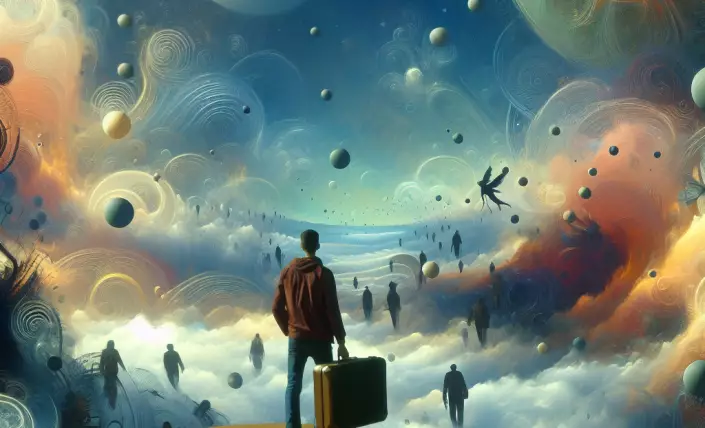
The void also manifests in our quest for meaning, a pursuit that often reveals more about our fears than our certainties. Consider a person standing on the precipice of a significant life decision, only to be paralyzed by the realization that no choice can be made with absolute assurance. Here, the void demands a confrontation with the self—a moment where the illusion of control is shattered. Yet, in this confrontation lies an opportunity: might embracing the void lead to a more profound understanding of freedom, one unbound by preconceived notions or societal expectations?
Creating Meaning
If the void is the backdrop to our existence, then the creation of meaning becomes an act of defiance against its vast emptiness. It is in the stories we tell, the relationships we nurture, and the values we uphold that we forge a semblance of order amidst chaos. Yet, this creation is not without its pitfalls, for every narrative we construct is contingent, susceptible to revision and reinterpretation. Does this instability undermine the very meaning we seek to create, or does it enrich it by allowing for growth and transformation?
Consider the artist standing before a blank canvas, each brushstroke a testament to the struggle between intention and interpretation. Here, meaning is not given but made, an ongoing dialogue between creator and creation. In this sense, the act of creating meaning is not a destination but a journey, one that demands courage to navigate its inherent uncertainties. How do we, as meaning-makers, balance the desire for permanence with the acceptance of transience?
Living Authentically
To live authentically is to embrace the complexities of existence without succumbing to the deceptive allure of simplicity. It requires a willingness to question the narratives that define us and to resist the comfort of conformity. Authenticity is not a static state to be achieved but an ongoing process of self-discovery and reinvention. Yet, this pursuit is fraught with challenges, as it demands an unflinching confrontation with the self and the world.
In a society that often equates authenticity with individuality, the quest to live authentically can become a solitary journey. But perhaps true authenticity lies not in isolation but in connection—recognizing our interdependence and the shared vulnerability of our condition. In this light, might authenticity be redefined not as the assertion of self, but as an acceptance of the other, a dialogue that transcends the boundaries of selfhood? As we navigate this intricate dance, we are left to ponder: what does it truly mean to live authentically in a world that is ever-changing and inherently uncertain?